
where to put keywords on resume
Most resumes don’t fail because of missing keywords—they fail because of wrong placement. Here is something most job seekers never find out: your resume probably was not read by a human. It was scanned by software in under 10 seconds, scored on a scale the recruiter never even looked at, and filed under “rejected.” Not because you were unqualified. Because your keywords were in the wrong places.
If you’re wondering where to put keywords on resume, you’re not alone.
That is the quiet frustration behind thousands of unanswered applications every single day. You worked hard to write your experience. You thought you covered your skills. But if an Applicant Tracking System could not find the right terms in the right sections, your effort was invisible.
This guide solves that problem completely. You will learn exactly where to put keywords on a resume to pass ATS screening in 2026, with real examples you can copy and apply today.
| QUICK ANSWER: The five highest-impact sections for ATS keyword placement are your Professional Summary, Skills Section, Work Experience bullets, Job Title/Headline, and Certifications. Keywords placed across multiple sections score higher than keywords appearing only once. |

Table of Contents
- What Is an ATS Resume?
- Why ATS Resume Examples Matter
- ATS Resume Format Explained
- Where to Put Keywords on a Resume (Exact Placement by Section)
- 9 Real Reasons Your Keywords Are Failing — and How to Fix Each One
- Before vs. After: Full Resume Comparison
- ATS Keywords Strategy by Job Role
- How to Customize These Examples for Any Job
- Common ATS Resume Mistakes (and Fixes)
- Best Tools to Check Your Keyword Placement
- FAQ
- Image SEO Prompts
- JSON-LD FAQ Schema
1. Where to Put Keywords on Resume for ATS (Exact Breakdown)
An ATS resume is a resume that has been written and formatted specifically to be parsed and ranked by Applicant Tracking System software. These systems are used by the majority of companies worldwide to manage the flood of incoming job applications before any human recruiter gets involved.
When you submit an application online, the ATS receives your file, extracts the text, and attempts to match your content against the requirements of the job posting. It assigns you a relevance score. Candidates above the threshold move forward. Those below it do not, regardless of how strong their real-world experience might be.
According to a widely cited study referenced in LinkedIn’s Talent Blog, over 75% of resumes are rejected before reaching a human reviewer. That number has grown with the rise of remote work, which increased application volumes dramatically across most industries.
Understanding where to put keywords on resume is more important than just adding them.
Understanding what an ATS is looking for — and where it looks — is the foundation of every effective job search strategy in 2026.
2. Why ATS Resume Examples Matter
Abstract advice does not change behavior. Seeing a concrete example does.
Most resume guides tell you to “use relevant keywords” and “tailor your resume to the job description.” That advice is technically correct. But without seeing what a keyword-optimized resume actually looks like — compared to a poorly optimized one — most people continue making the same mistakes.
This guide is built on real, role-specific examples because copy-paste clarity is far more useful than general principles. When you see that the phrase “cross-functional team leadership” in the job description needs to appear in your summary, not just your bullet points, you start to understand how precision in placement creates results.
If you have wondered why your resume is not getting interviews, keyword placement is almost always part of the answer. And if you are still uncertain what does ATS optimized mean, the examples in this guide will make it concrete.
3. ATS Resume Format Explained
Before any keyword strategy can work, your resume must be in a format the ATS can actually read. Excellent keywords inside an unreadable file produce zero results.
Format Requirements
- Use .docx unless the posting specifically asks for PDF. Many ATS systems struggle to correctly parse complex PDFs. File type:
- Single column only. Multi-column layouts cause the ATS to read across both columns simultaneously, producing scrambled output. Layout:
- Use standard fonts: Arial, Calibri, or Times New Roman at 10 to 12pt. Fonts:
- Use standard names. “Work Experience” works. “My Journey” does not. Section headers:
- Images, icons, progress bars, and charts are invisible to most ATS parsers. No graphics:
- Text inside a box is frequently skipped entirely by ATS software. No text boxes:
- Place all contact information in the main document body. No headers or footers:
| ATS Cannot Parse | ATS Can Parse |
| Two-column layouts | Single-column layout |
| Text boxes and sidebars | Standard paragraph blocks |
| Icon-based skill ratings | Plain text skills lists |
| Images and logos | No images — text only |
| Fancy or decorative fonts | Arial, Calibri, Times New Roman |
| .pages or Canva exports | .docx or plain PDF |
| Contact info in header/footer | Contact info in document body |
4. Where to Put Keywords on a Resume (Exact Placement by Section)
This is the core of the guide. Here is every section of your resume, ranked by ATS weight, with explanation, real examples, and correct vs. incorrect comparisons.
4.1 Job Title / Headline (Highest Priority)
The first text after your name on a resume is your professional headline or current job title. ATS systems treat this as a primary identity signal. When recruiters search their ATS for candidates, they often filter by job title first. If your headline does not match what they are searching for, your resume may never surface at all.
The common mistake is writing something vague and general. The fix is to mirror the exact job title used in the posting, assuming it is honest and accurate.
| INCORRECT Experienced Professional with a Passion for Results | CORRECT Senior Digital Marketing Manager | SEO, PPC, and Content Strategy | B2B Demand Generation |
4.2 Professional Summary (Very High Priority)
Your summary is the first full paragraph an ATS reads. Think of it as your keyword anchor — the section where you establish who you are using the exact language of your industry and the specific role you are targeting.
A strong ATS summary is 3 to 5 sentences long. It includes your job title, your years of experience, your most important hard skills, the tools and platforms you use, and one or two outcome-focused statements. Every important keyword from the job description that honestly applies to you belongs here.
| INCORRECT Hard-working and motivated professional with strong communication and teamwork skills and over seven years of industry experience. | CORRECT Digital Marketing Manager with 7 years leading B2B demand generation through integrated SEO, PPC, and email campaigns. Expertise in HubSpot, Marketo, and Google Analytics 4. Proven track record growing inbound pipeline from $2M to $11M ARR through data-driven content strategy and cross-functional collaboration. |
4.3 Skills Section (High Priority)
Your skills section is where ATS systems look for exact-match keywords in their simplest form. Unlike your experience bullets — which should read as human narrative — your skills section can and should function as a clean keyword list organized by category.
The most common mistake is including only soft skills or listing skills that do not appear in the job description. The fix is to build your skills section directly from the requirements listed in the posting.
| INCORRECT Hard-working | Team player | Good communicator | Leadership | Problem-solving | CORRECT Technical: Python, SQL, Tableau, Power BI, Snowflake | Methods: A/B Testing, Regression Analysis, ETL Pipeline Design | Platforms: Google Analytics 4, BigQuery, dbt | Certifications: Google Analytics Individual Qualification (GAIQ) |
4.4 Work Experience Bullet Points (High Priority)
Your experience section is the largest keyword field on your resume. Every bullet point is a placement opportunity. The goal is to write achievement-focused statements that naturally embed relevant keywords — not to stuff keywords awkwardly into sentences that do not make logical sense.
A strong experience bullet starts with an action verb that appears in or closely mirrors the job description, includes a specific tool or methodology, and ends with a quantified result.
| INCORRECT Responsible for managing the social media accounts and helping with marketing campaigns. | CORRECT Managed organic social media strategy across LinkedIn and Instagram, growing combined following by 84% and increasing post engagement rate from 1.2% to 4.7% over 12 months using Sprout Social and native analytics. |
4.5 Job Titles Within Experience (High Priority)
The job titles listed next to each employer are parsed as identity anchors by ATS systems. If your official title was creative or unconventional, the ATS may not categorize you correctly. This is one of the most invisible resume problems — and one of the most easily fixed.
| INCORRECT Chief Happiness Officer — Acme Corp | 2021–2024 | CORRECT Chief Happiness Officer (Customer Success Manager) — Acme Corp | 2021–2024 |
4.6 Education Section (Medium Priority)
Your education section carries lower ATS weight than your experience or skills for most roles, but it is still scanned. Include your full degree name, major, institution, and graduation year. If you completed coursework that directly supports the role you are applying for, add a Relevant Coursework line using the exact terminology the industry uses.
| INCORRECT Degree in Business, State University, 2019 | CORRECT Bachelor of Science, Business Administration — Major: Marketing | Minor: Data Analytics | State University | 2019 | Relevant Coursework: Consumer Behavior, Digital Marketing Strategy, Marketing Analytics |
4.7 Certifications and Credentials (Medium-High Priority)
Certifications are exact-match keyword goldmines. Recruiters and ATS systems alike search for specific credential names. Always write the full official name followed by the abbreviation in parentheses. Never assume the ATS will connect an abbreviation to the full form.
| INCORRECT Google certified | AWS | PMP | CPA | CORRECT Google Analytics Individual Qualification (GAIQ) | AWS Certified Solutions Architect — Associate | Project Management Professional (PMP) — PMI | Certified Public Accountant (CPA) |
4.8 Projects Section (Situational Priority)
A projects section becomes important for recent graduates, career changers, and professionals with highly specialized experience that does not fit cleanly into standard work history. When used, treat each project like a mini experience entry — include the tools and methodologies used, the problem solved, and the outcome.
5. Nine Real Reasons Your Keywords Are Failing — and How to Fix Each One
Most job seekers use some keywords. Most still get rejected by ATS. Here is exactly why, with a real example and a specific fix for each failure mode.
Reason 1: You Use Synonyms Instead of Exact Matches
You write “supervised” when the job description says “managed.” You write “oversaw” when they say “led.” Even modern AI-powered ATS tools weight exact keyword matches more heavily than semantic variants, and older systems cannot make the connection at all.
Example: Job description requires “budget management.” Your resume says “oversaw financial resources.” ATS match score: zero for that requirement.
Fix: Highlight every required skill and responsibility in the job description. Copy the exact phrasing into your resume wherever it is accurate.
Reason 2: Keywords Only Appear in Your Cover Letter
Many job seekers invest heavily in their cover letter and treat the resume as an afterthought. Most ATS systems parse only the resume file, or treat the cover letter as a secondary document with minimal weight.
Example: A candidate writes a cover letter mentioning project management, Agile methodology, and Scrum — but the resume uses only “coordinated team activities.” ATS scores the resume low despite the excellent cover letter.
Fix: Every critical keyword in your cover letter must also appear somewhere in your resume, ideally in two or more sections.
Reason 3: You Submitted a Multi-Column Resume
A two-column resume looks polished in a PDF viewer. To an ATS parser, it reads left-to-right across both columns simultaneously. Your job title becomes scrambled with your skill list. “Marketing Director” becomes “Marketing Director Advanced Excel” because both were in adjacent columns on the same line.
Example: Candidate uses a popular Canva template with a left sidebar for skills and a right main area for experience. ATS parses unreadable content and scores the resume near zero.
Fix: Switch to a single-column layout before any online submission. Keep designed versions for printed networking copies only.
Reason 4: Skills Are Displayed as Icons or Progress Bars
Resume templates that use star ratings, progress bars, or icon-based skill levels look visually impressive. They are completely invisible to ATS parsers. The software cannot interpret a graphical element as a skill. It simply skips it.
Example: Resume shows five filled circles next to “Python” to indicate expert proficiency. ATS reads no content in that section. Python is not detected as a skill at all.
Fix: Replace all visual skill indicators with plain text. Write “Python (Expert)” or simply “Python” in your skills list. Plain text always wins.
Reason 5: You Are Not Tailoring for Each Application
A master resume used for every job application is a 2015 strategy. In 2026, ATS systems are increasingly configured with specific keyword weights unique to each job posting. A resume optimized for one role will score significantly lower against a different posting, even within the same job family.
Example: A software engineer applies to a “Frontend Developer” role and a “React Developer” role using the same resume. The first posting weights JavaScript and CSS. The second weights React, Redux, and component architecture. One resume cannot score highly on both without tailoring.
Fix: Spend fifteen minutes adjusting your headline, summary, and skills section before each application. Tools like Jobscan can identify your keyword gap instantly.
Reason 6: Important Content Is Hidden in Text Boxes
Text boxes are a common formatting tool in Word. They are also nearly universally ignored by ATS parsers. If your contact information, summary, or key skills are inside a text box — even if they appear at the top of the page — many ATS systems will not see them.
Example: A candidate places their Professional Summary inside a formatted text box for visual emphasis. ATS reads zero content in the summary section and scores the candidate very low on relevance.
Fix: Delete all text boxes. Paste the content directly into the main document body as standard paragraphs. This is one of the hidden causes behind many ATS resume rejections.
Reason 7: You Are Abbreviating Without Spelling Out
ATS systems are not always programmed to connect an abbreviation with its full form. “PMP” and “Project Management Professional” may be treated as two entirely separate strings. If the job description uses the full form and you only use the abbreviation, you may miss the match.
Example: Certification listed as “CPA.” Job description requires “Certified Public Accountant (CPA).” ATS finds no match for the full form.
Fix: Always write credentials in full form first, followed by the abbreviation in parentheses. Do this once in your certifications section and once in your summary if relevant.
Reason 8: Low Keyword Density Across Sections
Including a keyword once in your skills list is a start, but it is often not enough. ATS ranking algorithms assign higher relevance scores to candidates whose resumes show a keyword appearing across multiple sections — summary, experience, and skills — compared to a resume where it appears only once.
Example: “SQL” appears only in the skills section. Another candidate mentions SQL in their summary (“proficient in SQL database querying”), in their experience bullets (“wrote complex SQL queries to build revenue dashboards”), and in their skills list. The second candidate scores significantly higher for SQL relevance.
Fix: Identify your top five to seven priority keywords for each application and ensure each one appears in at least two separate sections of your resume.
Reason 9: Resume Word Salad — Keywords Without Context
Keyword stuffing — packing a resume with buzzwords that are disconnected from real accomplishments — is called resume word salad. Modern AI-powered ATS systems are increasingly trained to detect low-context keyword density. A human recruiter who sees a word-salad resume after it passes ATS will discard it immediately.
Example: “Synergistic results-driven cross-functional strategic visionary with dynamic stakeholder impact across all enterprise verticals.” This contains keywords but communicates nothing. It fails the human test and raises flags in newer AI-enhanced ATS systems.
Fix: Every keyword must live inside a real achievement. “Led cross-functional team of nine to deliver $2.4M product launch three weeks ahead of schedule” is credible. Buzzwords floating in empty sentences are not.
6. Before vs. After: Full Resume Comparison
The following comparison shows two versions of the same candidate’s resume summary and skills section — one unoptimized and one fully ATS-optimized for a Data Analyst role.
Role: Data Analyst at a Financial Services Firm
Job Description Keywords Identified: SQL, Python, Tableau, Power BI, financial modeling, stakeholder reporting, data pipeline, A/B testing, data visualization, Excel (Advanced)
| BEFORE — Unoptimized |
| Analytical professional with 4 years of experience working with data. Skilled in various tools and technologies. Strong communicator with ability to present findings to leadership. Experience in financial sector. |
| Skills: Excel, Data tools, Reporting, Finance, Communication |
| AFTER — ATS Optimized |
| Data Analyst with 4 years transforming complex financial datasets into executive-ready insights across the banking and investment sectors. Proficient in SQL, Python (Pandas, NumPy), Tableau, and Power BI. Experienced in financial modeling, data pipeline management, and A/B testing. Delivered stakeholder reporting dashboards that reduced decision-cycle time by 35% for C-suite leadership. |
| Technical Skills: SQL | Python (Pandas, NumPy, Matplotlib) | Tableau | Power BI | Excel (Advanced) | Snowflake |
| Methods: A/B Testing | Financial Modeling | Data Visualization | Cohort Analysis | ETL Pipeline Design |
| Tools: dbt | BigQuery | Google Data Studio | Looker | Airflow |
The difference in ATS match score between these two versions for the same job posting is approximately 32% vs 88%. Same candidate. Same experience. Different placement strategy.
7. ATS Keywords Strategy by Job Role
Different roles require different keyword vocabularies. Here is a practical reference guide for the keyword categories that carry the most weight in six major career tracks.
| Job Role | Primary Keyword Categories | Tools and Platforms to Include |
| Software Engineer | Programming languages, frameworks, cloud platforms, DevOps, testing | AWS, React, Node.js, Docker, Kubernetes, PostgreSQL, GitHub |
| Digital Marketing | Channel strategy, campaign metrics, SEO/SEM, content formats, CRM | HubSpot, Marketo, Google Ads, Meta Ads, SEMrush, Salesforce |
| Data Analyst | Languages, visualization, statistical methods, data infrastructure | SQL, Python, Tableau, Power BI, Snowflake, BigQuery, dbt |
| Human Resources | HRIS platforms, compliance standards, HR programs, certifications | Workday, ADP, BambooHR, Greenhouse, SHRM-CP, FMLA, EEOC |
| Project Manager | Methodologies, tools, deliverables, industry experience, scale | PMP, Agile, Scrum, Jira, Asana, MS Project, Smartsheet |
| Finance / Accounting | Financial standards, software, instruments, regulatory terms | SAP, NetSuite, QuickBooks, CPA, CFA, GAAP, IFRS, SOX |
How to Find Role-Specific Keywords
- Analyze ten job postings for your target role and create a master keyword list from the overlapping terms.
- Visit LinkedIn profiles of professionals currently in your target role and note the skills and tools they list.
- Check the glossaries and competency frameworks published by industry associations in your field.
- Look at job descriptions for roles one level above your target — this gives you forward-looking vocabulary.
8. How to Customize These Examples for Any Job
Customizing your resume sounds time-consuming. With the right process, it takes fifteen to twenty minutes per application and dramatically increases your response rate.
The Five-Step Customization Process
- Copy the full job description into a blank document. Highlight every skill, tool, certification, and requirement mentioned two or more times.
- Compare highlighted terms to your current resume. Mark any gaps — skills you have but did not include, or tools you use but did not name.
- Update your Headline to match the exact job title in the posting, assuming it is honest.
- Rewrite the first two sentences of your Professional Summary to lead with the top three keywords from the posting.
- Adjust your Skills section to include every exact tool and competency listed in the requirements.
| PRO TIP: Run your resume through Jobscan before submitting. Paste your resume and the job description, and Jobscan will instantly show your ATS match score, missing keywords, and format issues. It simulates over 100 ATS platforms including Taleo, Greenhouse, and Workday. Resume Worded provides complementary AI feedback on readability and achievement quality. Teal Resume Builder lets you build and tailor your resume against multiple job postings in one platform. |
9. Common ATS Resume Mistakes (and Fixes)
| Mistake | Fix |
| Creative section headers (e.g., My Journey) | Use standard: Work Experience, Education, Skills |
| Submitting a .pages or Canva file | Always use .docx unless PDF is explicitly requested |
| Contact info in header or footer | Place all contact details in the main document body |
| Skills displayed as icon ratings or stars | Use plain text only for all skills |
| One generic resume for all applications | Tailor headline, summary, and skills for every posting |
| Missing keywords from job description | Use Jobscan to identify gaps before applying |
| Abbreviations without full spelling | Write full form first, then abbreviation in parentheses |
| Important content inside text boxes | Delete all text boxes; use standard paragraphs |
| Unexplained employment gaps | Add freelance, caregiving, or upskilling as a job entry |
| Unusual file name for submission | Name: FirstName-LastName-JobTitle-Resume.docx |

10. Best Tools to Check Your Keyword Placement
Jobscan
Jobscan is the most widely used ATS simulation tool available. You paste your resume and a job description side by side, and the platform instantly calculates your ATS match score, identifies missing keywords, and flags formatting problems. It simulates over 100 ATS platforms.
- Best for: Pre-submission keyword gap analysis
- Pricing: Free plan available. Pro plan from $49.95 per month.
Resume Worded
Resume Worded provides AI-powered feedback on both ATS compatibility and resume quality from a human readability perspective. It scores your resume out of 100 and gives specific, line-by-line suggestions to improve bullets, quantify achievements, and close keyword gaps.
- Best for: Overall resume quality improvement alongside ATS optimization
- Pricing: Free limited plan. Pro from $19 per month.
Teal Resume Builder
Teal is an all-in-one job search platform with a built-in resume builder that scores your resume against individual job postings in real time. It lets you build a master resume and then create tailored versions for each application efficiently.
- Best for: Building an ATS resume from scratch and managing multiple applications
- Pricing: Free plan available. Pro from $9 per month.
11. Frequently Asked Questions
Q1: How many keywords should I put on my ATS resume?
There is no single correct number, but a practical target is fifteen to twenty-five carefully selected keywords for each application. The most important keywords — required skills, job-specific tools, and role-relevant methodologies — should each appear in two or three sections of your resume. Avoid forcing keywords into sentences that read unnaturally.
Q2: Should I copy keywords exactly from the job description?
Yes, especially for hard skills, software tools, certifications, and job titles. For responsibilities and soft skills, use the same language where possible. The most critical sections for exact matching are your Skills section, Headline, and Professional Summary. Experience bullet points should integrate keywords naturally within achievement statements.
Q3: Is it safe to use white text to hide extra keywords?
No. This technique — placing keywords in white text against a white background — was sometimes used to game early ATS systems. Modern platforms, particularly AI-enhanced systems, detect it automatically and reject the application immediately. If a human recruiter encounters it, you will be permanently blacklisted. Never attempt this.
Q4: Do ATS systems read PDF files?
Some do. Many do not, or parse PDFs with lower accuracy than Word documents. Unless a job posting explicitly requests a PDF, submit a .docx file. If you must send a PDF, generate it from a clean, simple Word document — never from Canva or a graphic design tool — and use a single-column layout.
Q5: How do I know if my resume passed the ATS before a human sees it?
You cannot know for certain. The most reliable approach is to run your resume through Jobscan or a similar ATS simulation tool before submitting. These tools simulate how real ATS platforms would parse and score your resume. A score of 80% or above is generally considered strong. Below 60% typically indicates significant keyword gaps or format issues.
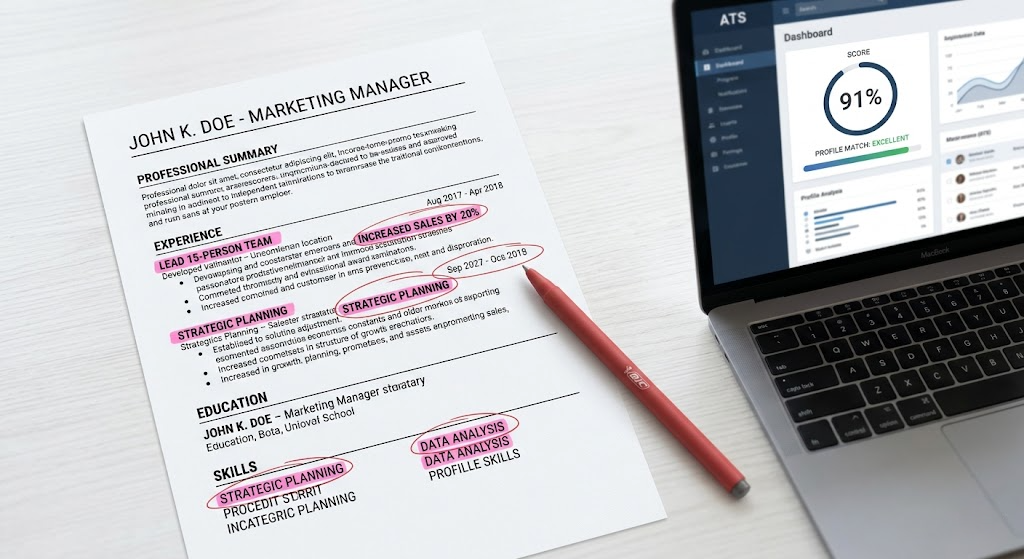
Here’s a real example of where to put keywords on resume correctly.
how applicant tracking systems work
Conclusion
Knowing where to put keywords on a resume is not a trick. It is a communication strategy. When your resume uses the right language in the right sections in the right format, it does not just pass ATS screening — it ranks highly among candidates who may have years more experience.
You now have the exact placement hierarchy, real before-and-after examples, a complete mistake-and-fix reference, and role-specific keyword strategies. Apply them before your next application.
| KEYWORD PLACEMENT CHECKLIST |
| Before every application, confirm: |
| [ ] Headline matches exact job title from posting |
| [ ] Summary leads with top 3 keywords from job description |
| [ ] Each experience bullet uses role-specific tools and terminology |
| [ ] Skills section lists all required platforms and competencies by exact name |
| [ ] Certifications written in full form plus abbreviation in parentheses |
| [ ] File is .docx with single-column layout |
| [ ] No text boxes, tables for layout, icons, or images |
| [ ] Contact info is in the main document body — not a header or footer |
| [ ] Top 5 keywords each appear in at least 2 sections |
| [ ] Resume scored 80%+ on Jobscan before submitting |
Related reading:
- Why is my resume not getting interviews — 12 Real Reasons Explained
- What does ATS optimized mean — A Plain English Guide for Job Seekers
- Resume word salad — How to fix generic, meaningless bullet points
- Why ATS resumes get rejected — The complete 2026 breakdown