

Greenhouse ATS resume optimization you spend an entire Sunday perfecting your resume for a role at Airbnb, HubSpot, or Shopify. You hit submit, feeling genuinely confident. Two weeks pass. Nothing.
You blame the competition. Maybe the timing. Maybe your experience wasn’t quite right.
But there’s another, far more frustrating possibility: your resume landed in Greenhouse — one of the most widely used applicant tracking systems in the tech and startup world — and it simply didn’t score well enough for a recruiter’s eyes to ever land on it.
Here’s the interesting part: Greenhouse is not like most ATS platforms. It operates differently from Taleo or Workday in ways that fundamentally change how you should optimize your resume. Most generic ATS resume advice misses this entirely. This guide won’t.
By the time you finish reading, you’ll understand exactly how Greenhouse processes, scores, and surfaces your application — and you’ll have a concrete, step-by-step plan to optimize every element of your resume for it.
| Quick Answer: How Do You Optimize a Resume for Greenhouse ATS? To optimize your resume for Greenhouse ATS, use a single-column .DOCX format with standard section headers (Work Experience, Education, Skills). Mirror the exact keywords from the job description — especially in your summary and skills sections — since Greenhouse stores the full document and makes it searchable. Use quantified achievements to score well on Greenhouse’s human-evaluated scorecard system. Avoid tables, columns, graphics, and creative fonts. Tailor every application to the specific job description’s language. |
What You’ll Learn in This Guide
- What makes Greenhouse ATS different from other systems
- How Greenhouse actually parses and scores your resume
- The Greenhouse Scorecard — the secret most guides ignore
- Step-by-step optimization process (12 concrete steps)
- Keyword strategy specifically for Greenhouse
- Formatting rules and critical mistakes to avoid
- Real before-and-after resume examples
- Which companies use Greenhouse (and what that means for you)
- Free tools to test your Greenhouse-readiness
- FAQ: Greenhouse ATS resume questions answered
1. What Makes Greenhouse ATS Different From Other Systems?
Before diving into optimization, you need to understand what sets Greenhouse apart — because the strategy that works for Taleo is not the same one that maximizes your performance in Greenhouse.
Greenhouse was founded in 2012 with a specific philosophy: that hiring should be structured, data-driven, and human-centric. That philosophy shapes everything about how the platform works, and it has important implications for anyone submitting a resume through it.
Key Differentiator #1: Greenhouse Is Human-Readable First
Most legacy ATS platforms parse your resume into a database and primarily surface candidates through algorithmic scoring. Greenhouse takes a different approach.
When you submit your resume through Greenhouse, the system stores both the parsed data AND the original formatted document. Recruiters see your actual resume — not just an extracted-text version. This means visual readability and presentation still matter in Greenhouse, even though the underlying parsing logic must also work correctly.
As Greenhouse CEO Daniel Chait has stated publicly: “It’s not about optimizing for a computer algorithm. It’s about optimizing for the person who’s going to look at the resume and deciding if they’re going to invest their time in meeting with you.”
The practical implication: your Greenhouse-optimized resume must pass the parser AND be genuinely compelling to a human reviewer. It’s a dual standard that most ATS guides don’t address.
Key Differentiator #2: The Scorecard System
This is the feature that most resume optimization guides completely miss when discussing Greenhouse — and it may be the most important thing you read in this entire article.
Greenhouse uses a structured “scorecard” system that hiring managers configure for every single job requisition. Before a single application arrives, the hiring team defines:
- Specific competencies and attributes the ideal candidate must demonstrate
- Required versus preferred qualifications, weighted differently
- Skills and experience levels that will be scored by human reviewers
- Structured interview questions that map to each scorecard attribute
When a recruiter or hiring manager reviews your application in Greenhouse, they score your resume against these pre-defined scorecard attributes — not against a generic algorithm. Multiple people on the hiring team submit independent scorecards. These scores aggregate into an overall candidate rating.
What does this mean for your resume? It means your optimization target is not just keyword frequency — it’s demonstrating specific competencies that map to the scorecard attributes. The more your resume visibly and concretely addresses the skills and qualifications listed in the job description, the higher your scorecard-based score will be.
Key Differentiator #3: Structured Hiring and DEI Integration
Greenhouse pioneered what the industry now calls “structured hiring” — a methodology where every step of the hiring process is standardized to reduce bias and improve decision quality. This includes anonymized resume review features that hide personal details in some configurations, standardized interview packages, and consistent evaluation criteria across all candidates for the same role.
For job seekers, this means Greenhouse-using companies are often more process-oriented and merit-focused than companies using simpler systems. Your resume needs to clearly demonstrate skills and achievements against objective criteria — subjective buzzwords and vague claims score poorly in structured hiring evaluations.
Key Differentiator #4: The Full-Document Search
Unlike some ATS platforms that only search extracted data fields, Greenhouse makes the entire submitted document searchable. This means keywords appearing anywhere in your resume can be found in recruiter searches — not just in parsed fields.
But here’s the catch: if your resume doesn’t parse correctly (due to columns, tables, or bad formatting), the extracted data fields will be wrong or missing, even if the full document is technically stored. Recruiter searches often prioritize parsed fields, so correct parsing still matters enormously.
2. Which Companies Use Greenhouse ATS? (And Why It Matters)
Greenhouse is used by over 7,500 companies worldwide, with particularly heavy concentration in tech, SaaS, fintech, digital media, and high-growth startup sectors. Understanding which types of companies use Greenhouse helps you calibrate your optimization strategy.
| Company Type | Example Companies | Why They Use Greenhouse |
| High-growth tech/SaaS | HubSpot, Shopify, Twilio, Zendesk | Scales with rapid hiring, structured process |
| Tech unicorns & scale-ups | Airbnb, Lyft, Warby Parker, Slack | Data-driven hiring, DEI reporting |
| Series B–D startups | Thousands of funded startups | Professional-grade ATS at growth stage |
| Digital media & content | Buzzfeed, Vox Media, The Atlantic | Collaborative hiring across teams |
| Fintech & professional services | Various fintech, consulting firms | Compliance features, structured evaluation |
| US-headquartered global firms | Companies expanding internationally | Multi-market hiring with consistent process |
The concentration in tech and SaaS means your resume entering a Greenhouse pipeline is likely being reviewed by technically sophisticated recruiters and hiring managers who will quickly recognize both good and bad resume practices. Generic, vague resumes score poorly. Specific, quantified, keyword-matched resumes score well.
3. How Greenhouse Parses Your Resume: The Technical Reality
When you submit your resume through a Greenhouse-powered careers page or job board, here is exactly what happens in sequence:
Step A: Document Ingestion and Format Processing
Greenhouse accepts .DOCX, .PDF, .RTF, and .TXT formats. The system begins by converting your document to extractable text. DOCX files are processed through XML extraction — the most reliable method. PDF files are processed differently depending on whether they are text-based (reliable) or image-based/OCR-dependent (unreliable).
According to multiple sources tracking ATS parsing reliability in 2025-2026, .DOCX files consistently produce the most accurate parsing results in Greenhouse, particularly for complex resume structures. While Greenhouse’s modern parser handles most text-based PDFs well, .DOCX remains the safest universal choice.
Step B: Section Detection and Data Extraction
Greenhouse’s parsing engine uses a combination of pattern matching, positional analysis, and natural language processing to identify and extract:
- Name and contact information (name, email, phone, location, LinkedIn URL)
- Work history (company names, job titles, employment dates, role descriptions)
- Education (institution, degree type, field of study, graduation year)
- Skills (technical skills, tools, certifications, competencies)
- Professional summary or objective
- Additional sections (awards, publications, volunteer work, languages)
The reliability of this extraction depends entirely on how clearly your resume signals where each type of information is. Standard section headers trigger correct classification. Non-standard headers, columns, and tables confuse the parser.
Step C: Database Storage and Keyword Indexing
Extracted data is stored in structured database fields (name, current title, skills, etc.) AND the original document is stored as a searchable file. This dual storage is what makes Greenhouse’s search particularly powerful for recruiters — they can search parsed fields for precise filtering AND full-text search the original document for context.
Step D: Human Review Queue with Scorecard Context
Unlike highly automated ATS platforms, Greenhouse doesn’t generate a single algorithm-based pass/fail score. Instead, it queues your application for human review with the scorecard attributes clearly visible to the reviewer. The human reviewer then assesses your resume against those attributes and submits their scorecard rating.
This is why the human-readability aspect of your resume is so critical in Greenhouse specifically. A well-formatted, clear, achievement-rich resume will score higher in human scorecard reviews than a keyword-stuffed but hard-to-read one.

4. The Complete 12-Step Greenhouse ATS Optimization Process
Now let’s get practical. Here is the complete, step-by-step process for optimizing your resume specifically for Greenhouse. Follow every step before you submit your next application to a Greenhouse-using company.
Step 1: Identify That the Company Uses Greenhouse
Before spending time on Greenhouse-specific optimization, confirm the company actually uses it. Here’s how:
- Check the application URL — Greenhouse-powered career pages typically have URLs containing “greenhouse.io” or “boards.greenhouse.net”
- Look at the job application interface — Greenhouse has a distinctive application layout
- Search “[Company name] Greenhouse ATS” to find mentions in job seeker communities
- Check job board URLs when roles are posted on LinkedIn or Indeed — Greenhouse integrations show in the apply link
Step 2: Extract and Categorize Job Description Keywords
This is the most important preparation step. Open the job description and create two lists:
- Required keywords: every specific skill, tool, technology, or qualification listed as required or mandatory
- Preferred keywords: skills listed as nice-to-have, preferred, or bonus
Then within required keywords, identify three tiers:
- Tier 1 — Job title keywords (exact role name and close variants)
- Tier 2 — Hard skills (specific tools, technologies, platforms, certifications)
- Tier 3 — Soft skills and competencies (leadership, communication, collaboration)
| EXAMPLE: Keyword Extraction from a Real Job Posting Job: Senior Product Manager — SaaS Growth at TechCo TIER 1 (Title Keywords): Product Manager, Senior PM, Product Management TIER 2 (Hard Skills): Agile, roadmap planning, Jira, A/B testing, SQL, user research, go-to-market strategy, SaaS metrics, NPS, product analytics, Mixpanel, Amplitude TIER 3 (Soft Skills): cross-functional collaboration, stakeholder communication, data-driven decision-making, customer empathy, strategic thinking ACRONYM PAIRS TO INCLUDE BOTH: A/B testing / split testing, OKRs / Objectives and Key Results, KPIs / Key Performance Indicators |
Step 3: Map Keywords to the Scorecard (The Greenhouse-Specific Move)
Here’s the step that no other optimization guide tells you about. Because Greenhouse uses a structured scorecard for every role, you can reverse-engineer what attributes the hiring team is likely scoring — and make sure your resume addresses each one explicitly.
How? Read the job description’s “Responsibilities” and “Requirements” sections as if they were a scorecard rubric. Each major responsibility or requirement likely maps to a scorecard attribute. Structure your resume so that each of these areas is demonstrably addressed with a specific, quantified example.
| Job Description Requirement (Likely Scorecard Attribute) | Resume Element That Addresses It |
| “5+ years experience managing cross-functional teams” | Job title + bullet: ‘Led cross-functional team of 14 engineers, designers, and marketers across 3 product launches’ |
| “Experience with data-driven product decisions” | Bullet: ‘Used Amplitude and SQL analysis to identify 23% drop-off at checkout; A/B test increased conversion 18%’ |
| “Strong stakeholder communication skills” | Summary + bullet: ‘Presented quarterly roadmap to C-suite and 200+ employee all-hands; facilitated alignment across 6 departments’ |
| “Agile/Scrum methodology experience” | Skills section: ‘Agile, Scrum, Jira, Sprint Planning’ + bullet mentioning Agile in context |
| “Go-to-market strategy experience” | Bullet: ‘Designed and executed go-to-market strategy for 3 SaaS product launches, achieving 140% of first-year revenue targets’ |
Step 4: Write or Rewrite Your Professional Summary
Your professional summary is the first thing a Greenhouse recruiter sees, and it’s where your most important keywords should be most concentrated. A well-written summary scores highly in both the parsing phase and the human scorecard review.
Your Greenhouse-optimized summary should include:
- Your exact job title (matching or closely mirroring the target role title)
- Years of experience with key specializations
- 2-3 primary hard skills from Tier 2 keywords
- One quantified achievement that immediately signals impact
- Industry context if relevant (SaaS, fintech, healthcare, etc.)
| BEFORE: Weak Summary (Low Scorecard Score) | AFTER: Greenhouse-Optimized Summary |
| Experienced product manager with a passion for building great products. I love working with teams and have helped companies grow their products. Strong communicator who is data-driven and always focused on the customer. | Senior Product Manager with 7 years driving SaaS growth through Agile product development and data- driven roadmap planning. Expertise in A/B testing, Mixpanel, and go-to-market strategy. Led 4 product launches achieving $12M ARR growth; reduced churn 28% through user research and NPS-driven iteration. |
Step 5: Optimize Your Technical Skills Section for Greenhouse Search
Greenhouse recruiters actively search the candidate database using keyword filters. Your skills section is the primary mechanism for matching these searches. Here’s how to structure it for maximum Greenhouse impact:
Use categorized skill groups rather than a flat list. This improves both ATS classification and human readability. Structure it as labeled rows:
| EXAMPLE: Greenhouse-Optimized Skills Section (Product Manager) Product Management: Product roadmap, Agile, Scrum, Sprint planning, backlog grooming, go-to-market strategy, product-led growth, OKRs Analytics & Data: Mixpanel, Amplitude, SQL, A/B testing, cohort analysis, funnel optimization, NPS, user research, Looker Project Tools: Jira, Confluence, Notion, Figma, Miro, Linear Business Skills: Stakeholder management, cross-functional leadership, product positioning, competitive analysis, pricing strategy Certifications: Certified Product Manager (AIPMM, 2024) |
Step 6: Rewrite Work Experience Bullets for Scorecard Alignment
This is where most job seekers leave massive points on the table. Generic job duty descriptions score poorly in Greenhouse scorecard reviews. Specific, quantified achievement statements score well — because they give reviewers concrete evidence to score each competency attribute.
Use this formula for every bullet point: Action Verb + Specific Task/Method + Quantified Result + Context/Scale
| BEFORE: Duty-Based Bullet Points | AFTER: Achievement-Based Bullet Points |
| • Responsible for product roadmap • Worked with engineering team • Managed A/B tests • Communicated with stakeholders • Improved user retention | • Defined and owned 18-month product roadmap for core SaaS platform ($24M ARR) • Collaborated with 12-person engineering team using Agile Scrum across 6 product sprints • Designed and analyzed 14 A/B tests in Amplitude, improving onboarding completion 34% • Presented quarterly roadmap to board and CEO; secured $2.4M budget for 3 new product initiatives • Reduced 30-day churn by 28% through user research, NPS analysis, and targeted iteration |
Step 7: Apply Greenhouse-Safe Formatting Rules
Now that your content is optimized, make sure your formatting doesn’t break the parser. Here are the non-negotiable formatting rules for Greenhouse:
| Formatting Element | Greenhouse Rule | Why It Matters |
| Layout | Single column only — no multi-column templates | Greenhouse parser reads left-to-right; columns scramble content |
| File Format | .DOCX strongly preferred | Most reliable parsing; .PDF acceptable if text-based, not scanned |
| Fonts | Arial, Calibri, Times New Roman (10-12pt body) | Non-standard fonts risk character recognition errors |
| Section Headers | Use exact standard names: Work Experience, Education, Skills, Summary | Parser relies on header recognition for correct data classification |
| Contact Info | In main document body — NOT in Word header/footer field | Word headers/footers are often not extracted by Greenhouse parser |
| Bullets | Standard solid bullets (•) or hyphens (-) only | Unicode arrows/symbols can garble in parsing |
| Tables | Avoid entirely for layout purposes | Table content can be read out of order or skipped |
| Graphics/Icons | Remove all images, profile photos, icon bullets, skill bars | Graphics are invisible to parser; text inside images is lost |
| Date Format | Month Year – Month Year (e.g., January 2022 – March 2024) | Consistent date format enables accurate tenure calculation |
| File Name | FirstName-LastName-Resume.docx | Professional; avoids special characters that can cause upload errors |
Step 8: Optimize Keyword Frequency (Without Stuffing)
Greenhouse recruiters use keyword search to find candidates in their database. According to Jobscan’s 2025 State of the Job Search report, 99.7% of recruiters use keyword filters in ATS platforms. Keyword frequency affects how high you appear in search results.
Here’s the Greenhouse-specific guidance on frequency:
- Primary keywords (most critical required skills): appear 3-4 times across summary, skills section, and 1-2 experience bullets
- Secondary keywords (preferred skills, related tools): appear 2-3 times across skills section and experience bullets
- Tertiary keywords (soft skills, competencies): appear 1-2 times, naturally embedded in context
Most job seekers miss this: both the spelled-out term and its acronym should appear together at first mention, then the shorter version can be used throughout. Example: “Product-Led Growth (PLG)” in the summary, then just “PLG” in bullets. This doubles your keyword match potential for either search variation.
Step 9: Craft an ATS-Optimized Education Section
The education section is often underutilized as an ATS keyword opportunity. For Greenhouse-specific optimization:
- List degree type in full AND abbreviated: “Bachelor of Science (B.S.) in Computer Science”
- Include graduation year in a clear format: “May 2019” or “2019”
- Add relevant coursework, honors, or thesis topics if they contain target keywords
- Place certifications in a separate section if you have more than two, or under Education for single certifications
- For bootcamp graduates, include the bootcamp name and technologies covered: “Full-Stack Web Development — React, Node.js, PostgreSQL (2023)”
Step 10: Add a Targeted Certifications and Professional Development Section
Certifications are among the highest-value ATS keywords because they are specific, verifiable, and often directly required by employers. For Greenhouse optimization, format certifications like this:
| EXAMPLE: ATS-Optimized Certifications Section Certified Product Manager (CPM) — AIPMM, 2024 Professional Scrum Product Owner I (PSPO I) — Scrum.org, 2023 Google Analytics Individual Qualification (GAIQ) — Google, 2024 SQL for Data Analysis — Mode Analytics, 2023 |
Always include the full certification name, the issuing organization, and the year obtained. Greenhouse’s parser is trained to recognize certification names as high-value keywords, and recruiters frequently filter for specific certifications.
Step 11: Tailor the Application Questions Thoughtfully
When applying through Greenhouse, most applications include custom screening questions configured by the hiring team. These are not an afterthought — they feed directly into the recruiter’s evaluation and often map to scorecard attributes.
Treat each application question as a mini-interview answer. Use specific examples with the STAR method (Situation, Task, Action, Result). Greenhouse ATS resume optimization Include keywords naturally. Avoid one-sentence generic answers — a recruiter who has just read your well-optimized resume will lose faith in it if your application question answers are vague.
Step 12: Test Your Resume Before Submitting
Before submitting to any Greenhouse-powered application, run these three tests:
- The Copy-Paste Test — paste your resume into Notepad/TextEdit. If your name, contact info, section headers, and bullet points all appear correctly in sequence, your parsing will likely be reliable.
- The Keyword Gap Test — use a free tool like Jobscan (which has Greenhouse-specific matching) to compare your resume against the job description. Aim for a match score above 70%.
- The Human Readability Test — print your resume or view it on a different screen. Can a recruiter spending 8 seconds scanning it immediately identify your role, top skills, and one key achievement? If not, revise.
5. Greenhouse Keyword Strategy: Industry-Specific Examples
The right keywords vary significantly by industry. Below are keyword clusters for four high-Greenhouse-usage sectors, drawn from the patterns most commonly found in roles at companies using this system.
Software Engineering Roles at Greenhouse Companies
| Keyword Type | Example Keywords |
| Languages/Frameworks | Python, JavaScript, TypeScript, React, Node.js, Go, Java, Ruby on Rails |
| Cloud/Infrastructure | AWS, GCP, Azure, Docker, Kubernetes, CI/CD, Terraform, microservices |
| Process/Methodology | Agile, Scrum, code review, TDD, system design, distributed systems |
| Soft Skills (Scorecard) | technical mentorship, cross-functional collaboration, engineering leadership |
Marketing and Growth Roles at Greenhouse Companies
| Keyword Type | Example Keywords |
| Performance Marketing | SEO, SEM, PPC, Google Ads, Meta Ads, paid acquisition, demand generation |
| Analytics | Google Analytics, Mixpanel, Amplitude, A/B testing, conversion optimization, attribution |
| Content/Brand | content marketing, brand strategy, copywriting, email marketing, HubSpot, Marketo |
| Soft Skills (Scorecard) | data-driven, growth mindset, stakeholder management, campaign reporting |
Sales and Customer Success Roles
| Keyword Type | Example Keywords |
| Sales Process | SaaS sales, B2B sales, outbound prospecting, pipeline management, quota attainment |
| Tools | Salesforce, HubSpot CRM, Outreach, Salesloft, Gong, ZoomInfo, LinkedIn Sales Navigator |
| Metrics | ARR, MRR, ACV, churn reduction, NRR, expansion revenue, NPS, CSAT |
| Soft Skills (Scorecard) | customer empathy, consultative selling, executive presence, cross-sell, upsell |
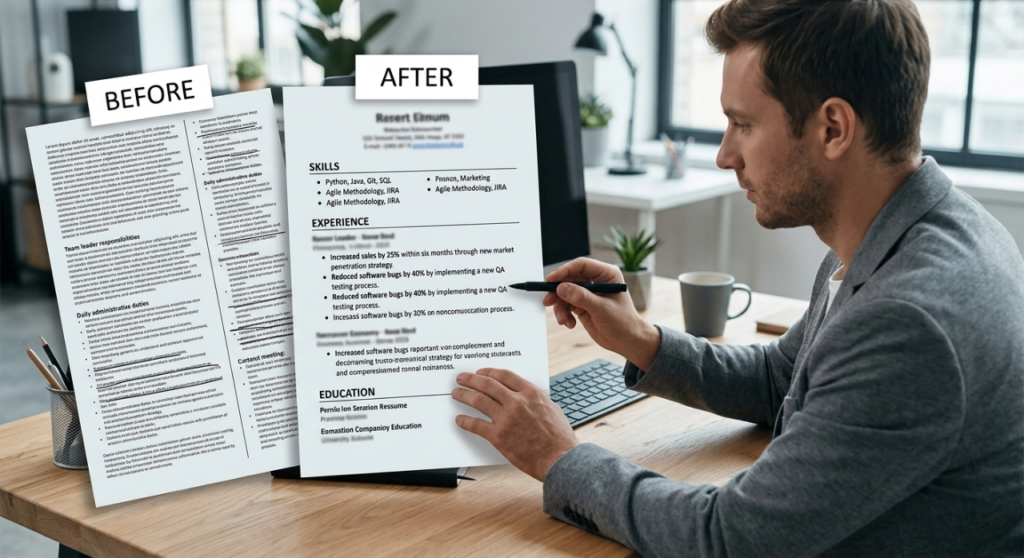
6. Full Before-and-After Resume Examples for Greenhouse
Case Study: UX Designer Applying to a Greenhouse-Using Tech Company
Below is a comprehensive before-and-after transformation of a UX Designer resume targeting a Product Design role at a mid-size SaaS company using Greenhouse ATS resume optimization.
| BEFORE: ATS-Failing Version | AFTER: Greenhouse-Optimized Version |
| ABOUT ME: Creative designer who loves creating beautiful digital experiences. Passionate about design and always learning new things. Team player and problem solver. MY WORK: UX Designer at TechStartup (2021-Now) – Designed stuff for the app – Worked with the engineering team – Created wireframes – Helped improve the product TOOLS I KNOW: Figma ★★★★★ Sketch ★★★★ Prototyping ★★★★ | PROFESSIONAL SUMMARY: Senior UX Designer with 5 years of experience creating user-centered digital experiences for SaaS products. Expert in Figma, design systems, and usability testing. Led end-to-end product design for mobile app redesign that increased DAU 42% and reduced user error rate 31%. WORK EXPERIENCE: Senior UX Designer — TechStartup | Jan 2021–Present • Designed complete UX for iOS/Android mobile app serving 180K users; A/B tested 8 design variations • Greenhouse ATS resume optimization Built and maintained Figma design system (200+ components) reducing design-to-dev handoff by 40% • Conducted 60+ user research sessions and usability tests informing 3 major product roadmap decisions SKILLS: Design: Figma, Sketch, Adobe XD, Principle, Framer, design systems, UI design, UX design Research: user research, usability testing, A/B testing, journey mapping, wireframing, prototyping Collaboration: Jira, Zeplin, Storybook, Agile/Scrum |
The optimized version addresses likely Greenhouse scorecard attributes directly: design execution quality (the app redesign metric), collaboration capability (design system, dev handoff), and user research competency (60+ sessions, roadmap impact). Greenhouse ATS resume optimization It contains 30+ relevant keywords and quantified achievements at every turn.
7. The 8 Most Common Greenhouse ATS Resume Mistakes
Now let’s look at what most job seekers get wrong when applying through Greenhouse specifically.
Mistake 1: Using a Designed Template from Canva or Resume.io
Canva templates almost universally use two-column layouts, text boxes, and embedded graphics — all of which cause Greenhouse parsing failures. Even “simple” Canva templates often have underlying structure issues that break text extraction. Greenhouse ATS resume optimization Save designed templates for networking and direct submissions; use a clean Word document for all Greenhouse applications.
Mistake 2: Generic Summary That Doesn’t Address Scorecard Attributes
Greenhouse-specific mistake: writing a generic summary that doesn’t speak to the specific competencies the role is scoring for. Scorecard reviewers will immediately see that your summary doesn’t address key attributes and score you lower. Greenhouse ATS resume optimization Every word of your summary should be tailored to what the job description signals the scorecard will measure.
Mistake 3: Listing Skills as Icon Ratings
“Python ★★★★☆” is completely invisible to Greenhouse’s parser. The rating icons communicate nothing. “Python (5 years, advanced)” or simply listing Python in a skills section is what works. Never use star ratings, percentage bars, or any visual skill-level indicator.
Mistake 4: Putting Contact Info in the Word Document Header Field
This is one of the most technically common mistakes. When you create your resume in Microsoft Word and place your name and contact information in the actual document “Header” region (Insert > Header), Greenhouse’s parser may not extract it. Greenhouse ATS resume optimization Your name and contact details will be missing from the database record. Always place contact information in the main document body.
Mistake 5: Ignoring the Greenhouse Application Questions
Greenhouse’s custom application questions are reviewed alongside your resume. Recruiters frequently report that weak application question answers override strong resumes. A thoughtful, keyword-rich, achievement-specific answer to Greenhouse ATS resume optimization “Describe your experience with Agile product development” can lift a borderline application into a strong yes.
Mistake 6: Submitting the Same Resume to Every Role
Greenhouse ATS resume optimization structured hiring means that scorecard attributes differ significantly between roles — even roles with the same title at different companies. A single generic resume cannot score well against multiple different scorecards. You must tailor your summary and lead experience bullets for every application.
Mistake 7: Using Non-Standard Date Formats
Greenhouse’s tenure calculation relies on date parsing. Formats like “Spring 2021” or “’21-’23” break this calculation. Greenhouse ATS resume optimization Use full month names or standard abbreviations with four-digit years consistently: “January 2021 – March 2024” or “Jan 2021 – Mar 2024.”
Mistake 8: Applying to Every Role at the Same Company Repeatedly
Here’s a less-known Greenhouse fact: your profile persists in the company’s Greenhouse database. Recruiters can see all your previous applications. Applying to 10 different roles at the same company in one week signals desperation and lack of focus. Be strategic — identify the one or two roles that genuinely match your experience and apply to those with a carefully optimized resume.
8. Free Tools to Test Your Greenhouse Resume Optimization
| Tool | What It Does | Best For | Cost |
| Jobscan | Compares your resume against job description; has Greenhouse-specific mode | Keyword gap analysis, match score | Free (limited) / Paid |
| Resume Worded | ATS compatibility check + keyword scoring | Overall ATS readiness review | Free (limited) / Paid |
| Rezi | AI-powered ATS optimization with keyword suggestions | Resume rewriting assistance | Free trial / Paid |
| SkillSyncer | Keyword matching + skills gap identification | Quick keyword gap check | Free (limited) / Paid |
| Hemingway App | Readability scoring for human review | Improving summary clarity | Free |
| Notepad/TextEdit | Copy-paste test for parsing check | Fast format verification | Free — always available |
Important caveat: Greenhouse ATS resume optimization no third-party tool perfectly replicates Greenhouse’s internal scoring logic, because Greenhouse’s scorecard-based evaluation is human-configured for each role. These tools are excellent for catching keyword gaps and formatting issues, but they can’t fully simulate the human scorecard review that ultimately determines your ranking in Greenhouse.

9. Related Guides: Build Your Complete ATS Strategy
Greenhouse optimization is one piece of a complete ATS strategy. These related guides on this site will help you master every dimension:
- ATS Resume Mistakes — The 15 most damaging errors across all ATS platforms and exactly how to fix them
- ATS Friendly Resume Format — The complete structural guide to formatting that passes every major ATS parser
- Resume Keywords for ATS — How to find, prioritize, and place keywords for maximum match scores
- ATS Resume Score — How to interpret and improve your ATS compatibility score across platforms
10. FAQ: Greenhouse ATS Resume Optimization
Q1: Does Greenhouse automatically reject resumes?
Greenhouse does not typically generate an automatic algorithmic rejection score the way some legacy ATS platforms do. Instead, Greenhouse ATS resume optimization it routes applications to human reviewers who evaluate them against scorecard criteria. However, Greenhouse ATS resume optimization if a company configures “knockout questions” — binary disqualifiers like required certifications or work authorization — failing those will result in automatic disqualification before human review. For all other applications, it’s human reviewers scoring you, not an automated pass/fail threshold. ATS Resume Score
Q2: Should I submit a PDF or DOCX to Greenhouse?
DOCX is generally the safer choice for Greenhouse. While Greenhouse’s modern parser handles text-based PDFs reasonably well, .DOCX files consistently produce more accurate parsing results — particularly for resumes with any formatting complexity. The one exception: Greenhouse ATS resume optimization if the job posting or application form explicitly requests a PDF. In that case, always follow the instructions. For maximum safety, keep both a. Greenhouse ATS resume optimization DOCX and a clean text-based PDF version of every resume.
Q3: How important are keywords in Greenhouse compared to other ATS systems?
Keywords matter in Greenhouse, but they work differently than in purely algorithmic systems. Because Greenhouse makes the full document searchable, keywords appearing anywhere in your resume can be found by recruiter searches. Frequency still matters — a recruiter searching for ‘product analytics’ will see candidates with more mentions ranked higher. Greenhouse ATS resume optimization But because Greenhouse uses human scorecard evaluation rather than pure algorithmic scoring, context and quality of keyword usage matters more than raw frequency. A keyword used once in a strong achievement statement often outperforms the same keyword listed five times in a flat skills list. 25 ATS Resume Examples That Pass Applicant Tracking Systems
Q4: Can I use a creative or visually designed resume for Greenhouse applications?
No — not for your primary application file. Greenhouse stores your original document and shows it to recruiters, which means visual presentation does matter to some extent. But the parsing requirements are strict: multi-column designs, tables, text boxes, graphic elements, and non-standard fonts all cause parsing problems. The best approach is a clean, Greenhouse ATS resume optimization single-column Word document that is both ATS-parseable and visually clean and professional. Greenhouse ATS resume optimization Save elaborate Canva designs for in-person networking or direct-email situations only.
Q5: How long does my profile stay in a company’s Greenhouse database?
Greenhouse retains candidate profiles for as long as the company’s data retention policy dictates — which varies by company and jurisdiction. Greenhouse ATS resume optimization Many companies retain profiles for 2-5 years. Some Greenhouse users actively search historical candidate databases when new roles open, which is why having an optimized, keyword-rich profile matters even after an application is closed. Under GDPR (for EU candidates) and similar regulations, you can request deletion of your data. Greenhouse provides companies with tools to manage data retention compliance.
Conclusion: Your Greenhouse ATS Action Plan
Optimizing your resume for Greenhouse ATS resume optimization is not about gaming a system — it’s about understanding how a well-designed, human-centric hiring platform actually works and presenting your genuine qualifications in the way that platform is designed to surface.How Does ATS Work
Greenhouse’s scorecard system rewards candidates who directly address the specific competencies each role requires. Its human-readability focus rewards clear, Greenhouse ATS resume optimization achievement-rich, well-formatted resumes over keyword-stuffed lists. Greenhouse ATS resume optimization And its full-document search capability rewards comprehensive keyword coverage across your entire resume. ATS Resume for Tech Jobs
Your Immediate Action Steps:
- Identify your next Greenhouse target role and confirm the company uses Greenhouse (check for greenhouse.io in the application URL)
- Extract and tier the keywords from the job description into Required Tier 1/2/3 lists
- Rewrite your professional summary to address the top Greenhouse ATS resume optimization 3-4 likely scorecard attributes
- Restructure your technical skills section into categorized groups with exact keyword matches
- Transform at least your 3 most recent experience bullets into quantified achievement statements
- Check your formatting against the Greenhouse rules table in this guide
- Run the copy-paste test and a Jobscan keyword gap analysis
- Submit — and track your results to refine your approach for future applications
The candidates who consistently succeed with Greenhouse-using companies are not necessarily the most qualified on paper. They’re the ones who understand how the system works and present their qualifications in the way the system — and the humans using it — are designed to find and reward.
That’s now you.
Sources & References
Greenhouse.com — Official Greenhouse ATS Platform Documentation
Jobscan — State of the Job Search 2025 Report (jobscan.co)
Society for Human Resource Management (SHRM) — ATS Usage Research
Greenhouse Support Documentation — Scorecard Overview (support.greenhouse.io)
U.S. Bureau of Labor Statistics — Occupational Outlook Handbook (bls.gov)