

How Does ATS Work Every year, tens of millions of job applications disappear into a digital black hole. Qualified candidates never hear back. Recruiters claim they’re overwhelmed with applications. And somewhere in the middle, How Does ATS Work a piece of software called an Applicant Tracking System is making decisions that shape careers.
If you’ve ever applied for a job online and received no response, there’s a good chance an ATS played a role in that silence. But here’s what’s surprising: How Does ATS Work most job seekers have no idea how these systems actually work. They optimize based on myths, guess at what keywords to use, and submit resumes formatted in ways that guarantee rejection. resume keywords for ATS
This guide pulls back the curtain completely. You’ll learn how ATS software processes your resume from the moment you click ‘Apply,’ how it scores and ranks your application, what recruiters actually see, and — most importantly — how to use this knowledge to dramatically improve your chances of landing interviews.
| Quick Answer: How Does an ATS Work? An Applicant Tracking System (ATS) works by receiving your resume, parsing it into structured data fields (name, contact info, work history, skills), storing it in a searchable database, and scoring it against the job requirements. Recruiters then search and filter this database to find matching candidates. Resumes that are hard to parse or missing key keywords rank lower or disappear entirely. |
What Is an Applicant Tracking System?
An Applicant Tracking System is enterprise software used by employers to manage the entire recruitment process — from job posting through to onboarding. At its core, it is a database and workflow management tool, but from a job seeker’s perspective, ATS resume score its most critical function is how it processes, stores, and ranks incoming resumes.
ATS software was first adopted by large enterprises in the early 1990s as a way to manage high volumes of paper resumes. As online job applications exploded in the 2000s — enabled by platforms like Monster, CareerBuilder, and eventually LinkedIn — ATS adoption spread to mid-size companies and then, How Does ATS Work through cloud-based SaaS models, to small businesses.
Today, according to research published by Jobscan and corroborated by SHRM (Society for Human Resource Management), over 98% of Fortune 500 companies use an ATS, How Does ATS Work and somewhere between 70-80% of all employers using online job applications rely on some form of applicant tracking technology. ATS resume examples
The implication is stark: if you apply for jobs online, your resume is almost certainly going through an ATS. Understanding how it works is not optional for the modern job seeker — it’s a fundamental career skill.
The Most Widely Used ATS Platforms in 2026
| ATS Platform | Primary Market | Market Share Estimate | Known For |
| Taleo (Oracle) | Large enterprise | ~25% | Complex workflow, strict PDF parsing |
| Workday | Enterprise/Mid-market | ~20% | Integrated HRIS + ATS, strong search |
| Greenhouse | Mid-market/Tech | ~15% | Structured hiring, AI scoring |
| iCIMS | Mid to large enterprise | ~12% | High-volume hiring, strict parsing |
| Lever | Growth companies | ~8% | Modern UI, good parser |
| BambooHR | Small-medium business | ~6% | User-friendly, lighter ATS features |
| SmartRecruiters | Global enterprise | ~5% | Marketplace integrations |
| Other/Custom | Various | ~9% | Varied parsing capabilities |
The Complete ATS Workflow: What Happens From Click to Interview
How Does ATS Work Understanding the ATS workflow from end to end gives you enormous strategic advantage. Here is exactly what happens after you click ‘Submit Application’:
Stage 1: Job Requisition Creation
How Does ATS Work Before you ever see a job posting, a recruiter or hiring manager creates a job requisition inside the ATS. This document contains the official job title, required qualifications, preferred qualifications, department, salary range, How Does ATS Work and — critically — a list of required and preferred keywords pulled from the job description.
Many ATS platforms allow recruiters to define a ‘knockout question’ set at this stage. These are hard filters — binary yes/no requirements that automatically disqualify any candidate who doesn’t meet them before any human review. Examples: ‘Do you have a valid CPA license?’ or ‘Are you authorized to work in the United States without sponsorship?’
Stage 2: Application Submission and Data Capture
When you submit your resume through an online portal, the ATS immediately begins several simultaneous processes. It logs the application timestamp, records the source (which job board, direct traffic, employee referral), captures your answers to any application questions, and queues your resume for parsing.
Most ATS platforms also create a candidate profile at this stage, which persists in their database beyond this single application. This is why some ATS platforms show you previous applications you’ve submitted to the same company years apart.
Stage 3: Resume Parsing — The Critical Transformation
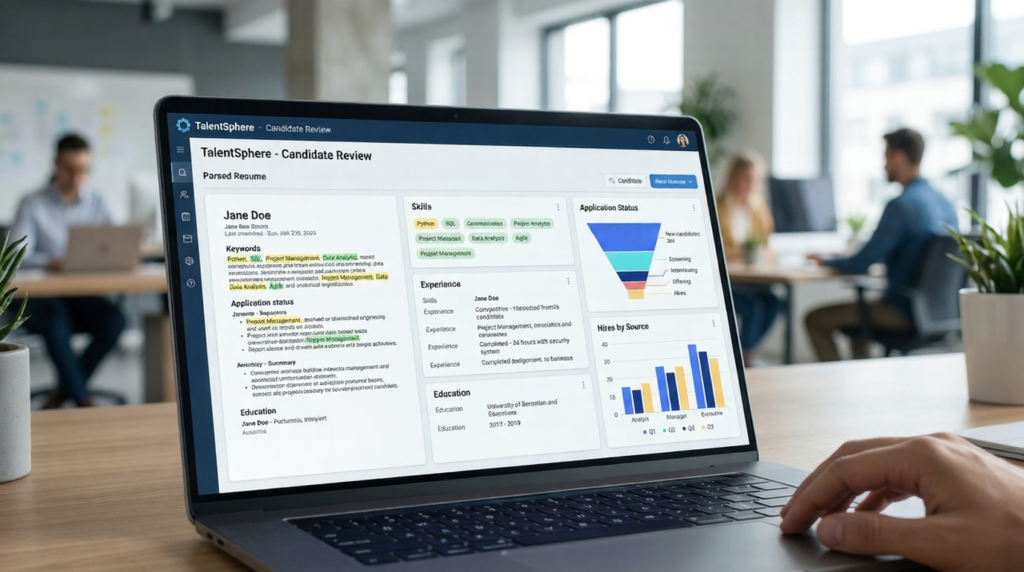
This is the most important and least understood stage of the ATS process. Resume parsing is the automated extraction and classification of information from your resume document into structured data fields.
The ATS attempts to identify and correctly store:
- Candidate name and contact information
- Work experience: company names, job titles, employment dates, and descriptions
- Education: institution names, degrees, graduation years, GPAs
- Skills: technical skills, soft skills, certifications, tools
- Summary or objective statement
- Awards, publications, or other supplementary sections
Now here’s the interesting part: this parsing process is entirely dependent on your resume’s structure. The ATS uses a combination of pattern recognition, positional analysis, and natural language processing to identify what each piece of text represents. When your formatting follows standard patterns, parsing is accurate. When it doesn’t — tables, columns, non-standard headers, images — the parsing process produces errors, misclassifications, or data loss.
Stage 4: Knockout Question Screening
After parsing, the ATS checks your application against the knockout criteria defined in the job requisition. These are binary filters. Common knockout criteria include:
- Minimum years of experience in a specific role or technology
- Required certifications or licenses (PMP, CPA, RN, etc.)
- Geographic location or willingness to relocate
- Work authorization status
- Education level minimum (bachelor’s degree or higher)
Applications that fail knockout criteria are typically moved to a ‘Does Not Meet Minimum Qualifications’ status automatically. Many ATS platforms send automated rejection emails at this point, which is why some candidates receive rejections within minutes of applying.
Stage 5: Keyword Matching and Candidate Scoring
This is where ATS platforms differ most significantly in their sophistication. All ATS systems perform some version of keyword matching — comparing the text extracted from your resume against the keywords and requirements from the job requisition. But they do it in very different ways.
Basic Keyword Matching (Legacy Systems)
Older or more basic ATS implementations perform simple Boolean keyword searches: does the word ‘Python’ appear in the resume? If yes, score one point. This is a purely literal matching process. It doesn’t understand context, doesn’t recognize synonyms, and doesn’t weight keywords by importance.
Under this model, the order in which keywords appear in your resume doesn’t matter, and a keyword appearing in your skills section is weighted the same as one mentioned incidentally in a job description bullet point.
Weighted Keyword Scoring (Modern Systems)
More sophisticated ATS platforms — including modern implementations of Greenhouse, Workday, and iCIMS — use weighted scoring models. Keywords marked as ‘required’ in the job requisition carry more scoring weight than ‘preferred’ keywords. Certain section placements may also carry more weight: a keyword appearing in the job title field or skills section may score higher than the same keyword buried in a job description paragraph.
AI-Powered Semantic Matching (Cutting-Edge Systems)
The most advanced ATS platforms now incorporate machine learning and natural language processing to perform semantic matching. Instead of just looking for exact keyword matches, these systems understand that ‘revenue generation’ and ‘sales growth’ describe similar concepts, or that ‘managed team of 12’ implies leadership experience even without the word ‘leadership.’
This is actually good news for well-written resumes — semantic matching rewards naturally written, contextually rich content over keyword-stuffed lists. But it also means that generic, sparse resumes score poorly even when they contain the right keywords, because they lack the contextual richness that AI scoring rewards.
| ATS Scoring Type | How It Works | What Scores Well |
| Basic Boolean | Exact keyword presence/absence | High keyword frequency, exact term matches |
| Weighted Keyword | Keywords scored by importance tier | Required terms in prominent positions, multiple matches |
| Semantic/AI | Contextual meaning and concept matching | Rich descriptions, quantified achievements, natural language |
| Hybrid | Combination of above methods | All of the above — most forgiving and most demanding |
Stage 6: Candidate Ranking and Recruiter Review
After scoring, the ATS presents recruiters with a ranked list of candidates. Depending on the platform and configuration, this might be a scored list with percentage match scores, a categorized list (Qualified, Unqualified, Maybe), or simply a chronological list with score indicators.
Recruiters typically start at the top of the ranked list and work down. In high-volume hiring situations, they may only review the top 10-20% of applications. If your resume scores in the bottom half due to ATS mistakes or keyword gaps, it may never receive human review.
Most job seekers miss this: even in companies that claim ‘every resume is reviewed,’ the ATS ranking still determines the order and emphasis of that review. A recruiter spending eight hours on 500 applications spends very different amounts of time on a #1-ranked candidate versus a #450-ranked one.
Stage 7: Interview Scheduling, Feedback, and Disposition
For candidates who advance past initial screening, the ATS manages interview scheduling (often integrated with calendar tools like Google Calendar or Outlook), collects structured interview feedback from panel members, tracks hiring decision stages, and ultimately records the final disposition — hired, declined, or kept in the talent pool for future positions.
The talent pool function is worth understanding: when you’re rejected for one role, many ATS platforms retain your profile. Some companies actively search this database when new roles open. Having an ATS-parseable, keyword-rich resume means your profile remains discoverable for future opportunities even after a rejection.
How ATS Parsing Works in Technical Detail
Let’s get specific about the parsing process, because this is where most resume optimization advice goes wrong — it focuses only on keywords without addressing the underlying technical requirements that determine whether those keywords are ever successfully extracted.
Document Format Processing
When your resume file arrives at the ATS, the first operation is format processing — converting the document format (DOCX, PDF, TXT, RTF) into raw text that the parsing engine can analyze.
DOCX files are processed by reading the underlying XML structure. This is generally the most reliable extraction method, as the XML clearly defines text blocks, paragraphs, and most formatting elements.
PDF files are more complex. Native PDFs (created by exporting a Word document) typically have a text layer that can be extracted directly. Scanned PDFs or those created by certain design tools (Canva, InDesign) may require OCR (Optical Character Recognition), which introduces potential errors. Even native PDFs can cause problems if the PDF was created with text in text boxes rather than the document flow.
Section Detection and Classification
After extracting raw text, the ATS parser must identify which sections of your resume correspond to which structured fields in its database. It does this using:
- Header recognition: Looking for section labels like ‘Work Experience,’ ‘Education,’ ‘Skills’
- Positional heuristics: Assuming the first section after contact info is the summary, work history follows, etc.
- Pattern matching: Looking for date patterns (mm/yyyy) as indicators of work history or education entries
- Named entity recognition: Identifying company names, school names, degree types, and certification names
When any of these recognition processes encounter formatting that doesn’t match expected patterns — creative headers, columns, tables, text in image form — the classification fails and content gets lost or misclassified.
Real Parsing Test: What ATS Extracts From a Sample Resume
| Resume Section | ATS Successfully Extracts | ATS Often Misses or Scrambles |
| Contact Info (body) | Name, email, phone, LinkedIn URL | Info placed in Word header/footer |
| Work History | Companies, titles, dates, descriptions | Info inside tables or side columns |
| Education | School, degree, graduation year | GPA in unusual format, honors in creative sections |
| Skills | Keywords from dedicated skills section | Skills shown as icon ratings or embedded in graphics |
| Summary | Full text if using standard header | Content if labeled ‘My Story’ or similar creative title |
| Certifications | Cert name, issuer, date (if standard format) | Certs embedded in sidebar columns |
What Recruiters Actually See When They Open Your ATS Profile
This section is one most guides completely skip — what the ATS interface actually looks like from the recruiter’s side, and how that shapes the candidate review experience.
When a recruiter opens your ATS candidate profile, they typically see:
- Your parsed contact information and basic demographics
- Your ATS match score or percentage (if the platform shows this)
- A parsed/formatted view of your resume content — not your original document layout
- Your answers to application screening questions
- Application source and timestamp
- Any notes or tags from previous recruiters in the same ATS database
Here’s the critical insight: recruiters are often looking at a parsed, reformatted version of your resume — not your beautifully designed original. This means the visual presentation of your resume (the design you labored over) is often irrelevant to the ATS review stage. What matters is whether the correct information was extracted correctly and whether it matches what the recruiter is looking for.

How to Optimize Your Resume Based on How ATS Works
Now that you understand the full ATS workflow, here is a strategic framework for resume optimization that works with how these systems actually function — not against them.
Optimization Layer 1: Structural Integrity (Pass the Parser)
The first goal is simply to make sure your resume can be accurately parsed. This means:
- Single-column layout with no tables for layout purposes
- All contact information in the document body (not Word header/footer)
- Standard section headers that ATS systems recognize
- ATS-safe fonts (Arial, Calibri, Times New Roman)
- Saved as .DOCX for maximum compatibility
- No images, graphics, icons, or skill bars
Optimization Layer 2: Keyword Strategy (Score High in Matching)
Once your resume can be parsed correctly, the next goal is maximizing your keyword match score:
- Extract the 10-15 most important skill and qualification terms from the job description
- Include both the full term and its acronym (Search Engine Optimization / SEO)
- Place primary keywords in your summary, skills section, AND work experience
- Use the job description’s exact phrasing rather than synonyms when possible
- Customize your skills section for each application
Optimization Layer 3: Content Quality (Score High in AI Semantic Matching)
For ATS platforms using AI and semantic matching — which is increasingly the majority — rich, contextual content scores higher than sparse keyword lists:
- Quantify every achievement with numbers, percentages, or dollar amounts
- Use varied action verbs that imply the scope of your impact
- Include context that demonstrates the scale and complexity of your work
- Write your summary to speak directly to the specific role and company
ATS Keywords: A Real-World Optimization Example
Let’s walk through a concrete example of how keyword optimization works for a specific role.
Job Posting Excerpt: How Does ATS Work ‘We’re looking for a Data Analyst with experience in SQL, Python, and Tableau. You’ll work with cross-functional teams to deliver actionable insights from large datasets, support business intelligence initiatives, and communicate findings to non-technical stakeholders.’
| Keyword Type | Examples from This Job | Frequency in Job Description |
| Primary Required Skills | SQL, Python, Tableau | High — appear multiple times |
| Role-Related Keywords | Data Analyst, business intelligence, BI | High |
| Soft Skills / Competencies | communication, cross-functional, stakeholder | Medium |
| Task Keywords | actionable insights, large datasets, data analysis | Medium |
| Implied Keywords | data visualization, reporting, ETL, dashboard | Not stated but expected |
Before Optimization: Weak Resume Summary
| BEFORE: Generic Summary (Low ATS Score) Experienced analyst with strong technical skills and a passion for data. Good communicator who works well with teams and has experience with various data tools and databases. How Does ATS Work Looking for an opportunity to apply my skills in a challenging environment. |
After Optimization: ATS-Targeted Resume Summary
| AFTER: Optimized Summary (High ATS Score) Data Analyst with 5 years of experience leveraging SQL, Python, and Tableau to deliver actionable insights from large datasets. Proven ability to support business intelligence initiatives and translate complex data findings into clear recommendations for non-technical stakeholders. Experienced in cross-functional collaboration with marketing, product, and operations teams to drive data-informed decisions. |
The optimized version contains all the primary required keywords (SQL, Python, Tableau, Data Analyst, actionable insights, large datasets, business intelligence, How Does ATS Work non-technical stakeholders, cross-functional) while reading naturally and compellingly to human reviewers.
Internal Resources: Next Steps for ATS Success
Understanding how ATS works is the foundation — now build on it:
- ATS Resume Mistakes — The 15 most common errors and how to fix them fast
- Resume Keywords for ATS — A complete guide to keyword research and optimization
- ATS Resume Format Guide — The exact structure and layout that scores highest
- ATS Resume Score — How to test and interpret your ATS compatibility score
FAQ: How Does ATS Work?
1. Does ATS automatically reject resumes?
Yes, in many cases. ATS systems can be configured to automatically reject applications that fail knockout questions, fall below a minimum match score threshold, or don’t meet hard requirements like required certifications. Some estimates suggest 75% of resumes are never seen by human eyes due to ATS filtering. However, configurations vary significantly by company and role.
2. Can ATS read LinkedIn profile imports?
Most modern ATS platforms have LinkedIn integration that can import your profile data directly. This process bypasses the document parsing step but still applies keyword matching and scoring.How Does ATS Work Interestingly, LinkedIn-imported profiles often parse more reliably than resume documents because the data comes in a structured format the ATS expects.
3. How long does my resume stay in an ATS database?
This varies by company policy and ATS platform. How Does ATS Work Many enterprise ATS systems retain candidate data for two to five years, or for as long as the company’s data retention policy allows. Some candidates have been contacted for roles years after their initial application. This is why maintaining an ATS-optimized profile matters even after a rejection.
4. Does ATS see my resume design or just the text?
In almost all cases, ATS systems work with extracted text and structured data, not your visual design. The ATS rendering of your resume is a plain-text or simply formatted display of your parsed information — not your original designed document. How Does ATS Work This means design investments that don’t affect text content are largely invisible to ATS systems.
5. Do small companies use ATS?
Increasingly, yes. While enterprise ATS platforms like Taleo and Workday dominate large companies, cloud-based ATS solutions like BambooHR, Breezy HR, How Does ATS Work and Recruiter have made applicant tracking accessible to companies with fewer than 50 employees. If you’re applying through an online form or job board integration rather than directly emailing a hiring manager, there’s likely some form of ATS involved.
Conclusion: Use ATS Knowledge as a Competitive Advantage
Most job seekers treat the ATS as a mysterious black box — something they know exists but can’t understand. The candidates who consistently land interviews treat it differently. They understand the workflow, optimize for the parsing and scoring process, How Does ATS Work and think strategically about how their resume appears in a recruiter’s ATS dashboard.
The good news is that ATS systems, for all their complexity, follow predictable rules. And rules can be learned, optimized for, and beaten — not through tricks or hacks, but through genuine understanding of what these systems are trying to accomplish: How Does ATS Work efficiently connecting qualified candidates with appropriate jobs.
Apply the knowledge in this guide, and you won’t just pass the ATS. You’ll rank at the top of it.
Sources: Society for Human Resource Management (SHRM) | Jobscan ATS Research 2025 | U.S. Department of Labor | Gartner HR Technology Reports